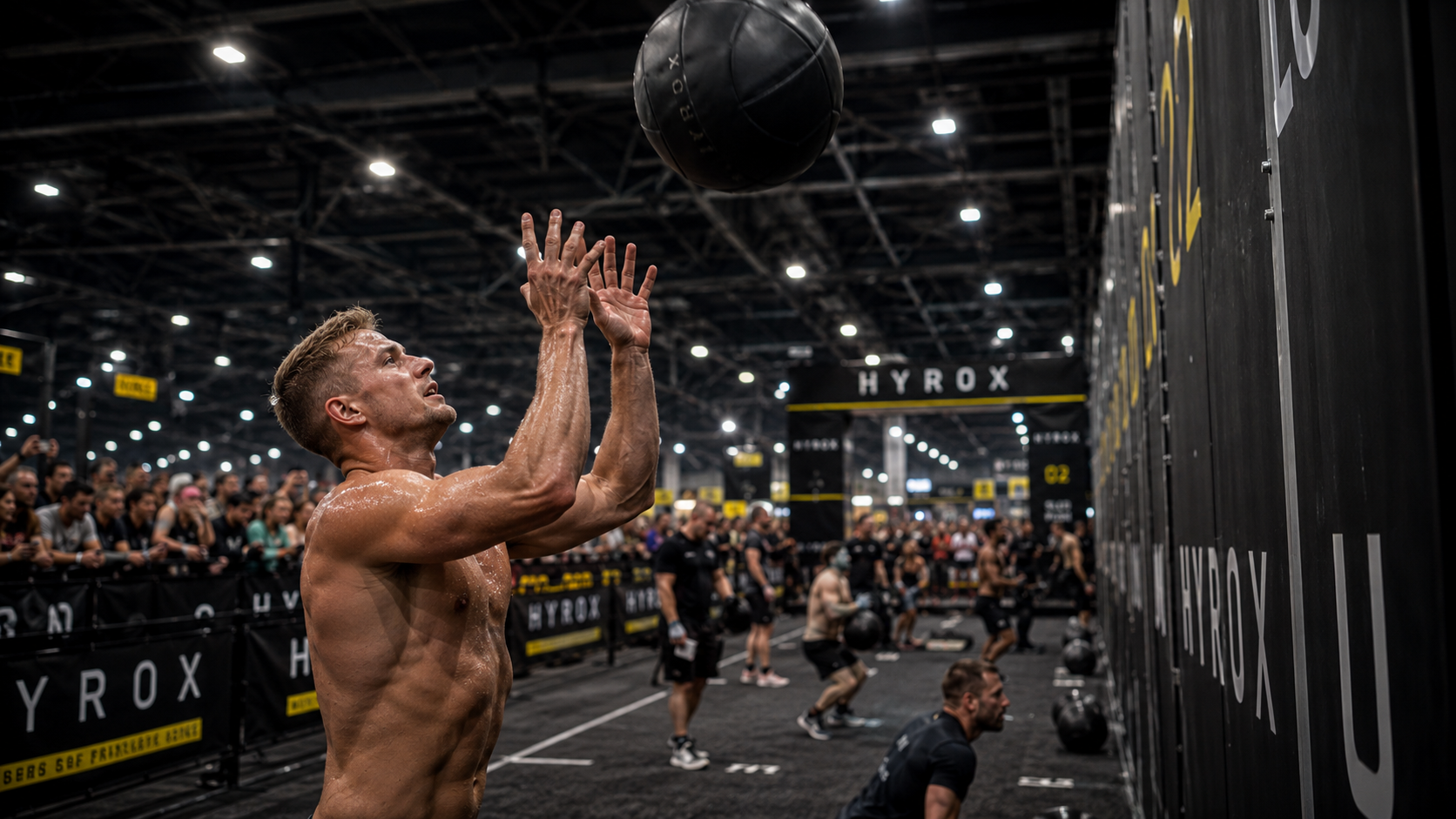
Dan Plews lost by 40 seconds. To a two-time CrossFit Games champion. In his first ever pro HYROX race.
For someone who built his engine over 15 years of triathlon, still holds the Kona age-group course record at 8:24, and was the first amateur ever to break 8 hours in an Ironman, that’s a strange result. Plews has no CrossFit background at all. He nearly beat one of the best hybrid athletes alive.
That gap is where things got interesting when Plews sat down with Dr. Martin Buchheit on the Training Science Podcast. What actually transfers from endurance sport into HYROX? How much strength does the race need? And why might training strength and endurance in the same session be working against you?
A sport stuck in the middle
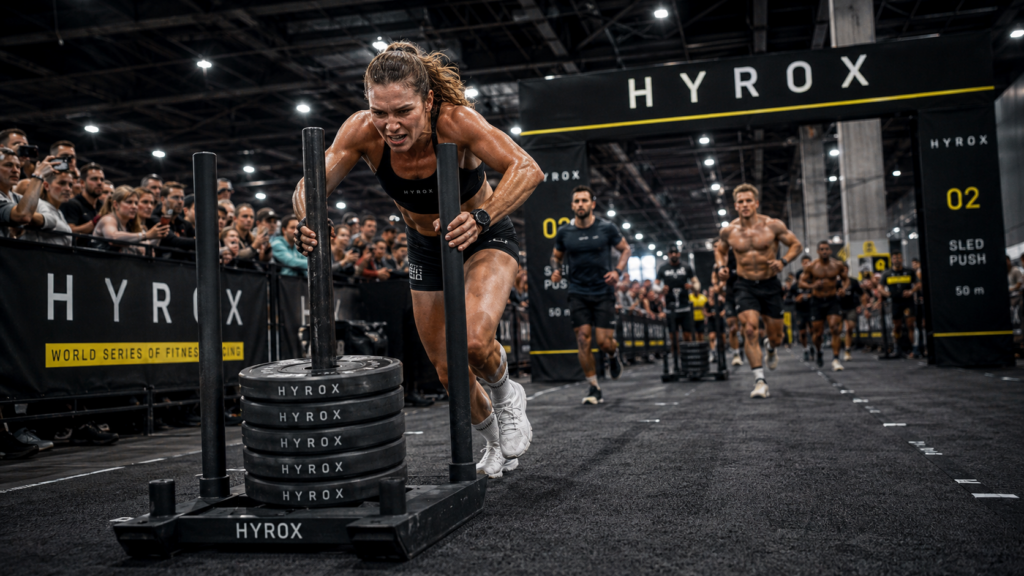
Plews thinks of hybrid sports on a continuum. Triathlon sits at one end: pure endurance, 8 to 10 hours, no real ceiling on how much volume helps. Olympic lifting sits at the other: one maximal effort, zero need to repeat it. CrossFit leans toward the power end. HYROX lands between the two, closer to CrossFit, but still built around close to an hour of continuous output: eight rounds of a 1-kilometer run into a station, ski erg, sled push, sled pull, burpees, rowing, farmer’s carry, lunges, wall balls, back to back, no rest. In the pro division, the sled push alone jumps to 202 kilos.
Here’s the twist. Being faster at triathlon doesn’t reliably predict being better at HYROX. Plews named a training partner who was 30 minutes slower than him at Kona, yet finished fourth at the HYROX World Championships. Endurance clearly transfers. It just doesn’t transfer in a straight line.
Train it separate. Don’t mix it.

This is the part every hybrid athlete should steal. Plews structures his week around one rule: strength and endurance stay in different sessions, ideally different days. The reasoning is concurrent training 101, but he takes it further than most. Walk into a strength session with tired legs from earlier metabolic work, and the force output drops, and so does the adaptation. So he trains strength on Monday, Thursday, and Sunday, spaced as far apart as the week allows, and does nothing else on those days. Any aerobic work near a strength day stays short and easy.
He’s tested both extremes on himself. After his last Ironman in 2023, he ran an 8-month bodybuilding block, six 90-minute sessions a week, and went from 74 kilos to 89. He didn’t love it, but the extra mass turned out to matter: pushing a 202-kilo sled is a lot easier with bodyweight behind it. Now, racing pro, his blocks are tighter. Six weeks, heavy compound lifts, no supersets, no conditioning circuit bolted on afterward.
There’s also a fork in the road depending on the athlete. Fast, explosive athletes fatigue hard and fast. Slower, more aerobic athletes hold steady but lack top-end power. If Plews’ CrossFit rival asked him to coach him, he said he’d flip his own program entirely: cut maximal strength to almost nothing, and load up aerobic volume instead, mostly on the bike rather than the road, since bigger, more powerful athletes rarely absorb 50 to 80 kilometers of running a week without breaking down.
Zone 2 isn’t the hero it’s made out to be
Buchheit brought up Plews’ own PhD research on heart rate variability, and Plews doesn’t hedge on it. Training below the first threshold, what most people now call zone 2, raised HRV. Training between the first and second thresholds did nothing to it. High-intensity work suppressed it. Think of HRV as a sink with limited depth: zone 2 turns the tap on and fills it back up, intensity pulls the plug and lets it drain. A polarized program needs both cycles running, or there’s nothing left to drain.
But Plews won’t call zone 2 the most important thing an athlete can do. Its real value is that it lets you bank huge volume safely, and the peripheral adaptations that come with volume, mitochondrial density among them, need real hours, not 40-minute sessions. He points to a study from Paul Laursen’s own PhD, 30 seconds on, 4 minutes off, that was designed around anaerobic capacity and still produced strong aerobic adaptations. His prediction: an athlete who only has two sessions a week will get fitter doing two hard ones than two easy ones.
Can you get too strong for HYROX?
Here’s the anecdote worth remembering. At the Brisbane weekend, Plews and his colleague Adam Storey, who has coached Olympic shot put champion Valerie Adams, compared notes on two Elite 15 athletes at a similar level. One had a 70-kilo max bench press. The other had 150 kilos. The 70-kilo lifter beat the 150-kilo lifter at the World Championships. Neither Plews nor Storey has a confirmed reason why, though Plews suspects heavy strength work might shift lactate kinetics in a way that works against a sustained hour-long effort. HYROX has only existed since 2018, so this is still an open question.
What isn’t in question: most of a HYROX race sits around 60 percent of an athlete’s one-rep max, repeated continuously for close to an hour. Raw maximal strength isn’t the limiter. The ability to hold a moderate load under real fatigue is.
Day to day, Plews keeps it simple: daily HRV and resting heart rate, running performance against known pace and heart rate benchmarks, and timed HYROX movements like burpee broad jumps and walking lunges as a proxy for conditioning. He and Storey are now building a HYROX-specific coaching arm, Endurox, alongside his triathlon business, Endure IQ. One of them owns the aerobic side. One owns the strength side. Even the people coaching this sport professionally don’t try to be expert in both halves of it at once.
Quick answers
Does an endurance background help in HYROX? Yes, more reliably than a strength background. Endurance athletes usually arrive with the aerobic engine already built and mainly need to add strength and station technique.
Should you train strength and endurance in the same session? Avoid it where possible. Residual fatigue from earlier metabolic work reduces the force output, and the training stimulus, in a strength session.
Can you be too strong for HYROX? Possibly. Elite coaches have seen athletes get worse at HYROX past a certain strength threshold, though the exact mechanism isn’t confirmed yet.
What matters more for HYROX, zone 2 or high intensity? Neither wins by default. Zone 2 lets you bank more safe volume; high intensity gets more done per hour when time is limited.
Get more of this
HIIT Science breaks down research like this every week for coaches and athletes who want their programming decisions backed by data instead of guesswork. Join the community to get the next breakdown.
Curious what’s new in HIIT Science’s course library? Click here
If Hyrox is on your calendar, check out Athletica’s Hyrox training plans.
Monitoring Load and Response in Elite Football
Unlock Your Team’s Potential with Martin Buchheit’s Science-Proven new Course